Nothing Like Designer Jeans

I’m listening to Pandora right now, and Whitesnake’s “Is This Love” happens to be playing. What were the hottest jeans from 1988? Maybe they were Guess?, maybe they were Girbaud (with the little loop at the top of the fly). I remember that it was important for guys to have Levi’s, at least in the little town where I was attending school when Tawny Kitaen was straddling two Jaguars.

There’s trends in medicine too. Remember how just over a century ago, no one really had a grasp on how important it was to wash your hands? And remember how 80 years ago, antibiotics were just around the corner, but before they were available to the general public, syphilis could very well be a death sentence? But it’s not so much trends as it is that we become more aware and educated.

Medicine attempted to treat PTSD in soldiers and document it for as long as wars have been fought. Different names have been attached to it; “Soldier’s heart” for the Civil War, “shell shock” for World War I; and “Combat Stress Reaction” for World War II.

After WWII, the American Psychiatric Association worked to put together a label that would apply to all symptoms that would appear as a result of traumatic events, not just war. It has actually been through five revisions to date and includes four different types of symptoms: reliving the traumatic event (also called re-experiencing or intrusion); avoiding situations that are reminders of the event; negative changes in beliefs and feelings; and feeling keyed up (also called hyperarousal or over-reactive to situations). Most people experience some of these symptoms after a traumatic event, so PTSD is not diagnosed unless all four types of symptoms last for at least a month and cause significant distress or problems with day-to-day functioning (see PTSD: National Center for PTSD ).

Since I’m part of the Chronic Illness Bloggers network, I’ve been able to read a lot of my fellow bloggers’ unique perspectives, and more than once I’ve seen references come up about PTSD in medical settings. I cannot believe what some of you have had to endure. I worry about putting on my Girbaud jeans and raising my hand and saying “Me too,” but after having many discussions with my counselor, she has confirmed that I indeed have PTSD triggered by my experiences brought on by this mystery disease.

Was there one big bang? I don’t think so, just like there isn’t one big battle in war, but a whole war. There were certain things that were especially traumatic. The time that my neurosurgeon stood in the doorway of my hospital room on the night of my birthday in 2013 after my fourth surgery and told me he would have to send me home nearly blind because he was just in there and it had to be something else, not a shunt failure was especially traumatic (turns out that it was a kink in the shunt that developed that would not have been discovered if I would not have thrown a hysterical fit to have a nuclear shunt study performed).

One story that I told to my counselor in this week’s session happened January 2014. 2013 was my big year of surgeries – six in all. I got to know my symptoms of shunt failure really well, plus I figured out that I was making copious scar tissue and adhering the shunt to my chest and abdominal wall. At various times I also leaked great big pools of CSF out of my spine so that I had a softball-sized vat of fluid sitting on my back, and a more dangerous situation of having a shunt in my brain and another one in my back, making it harder to control pressure.

My last surgery in 2013 was December 21st; that was when my neurosurgeon finally believed me after 2.5 years that I was allergic to the shunt, when he saw for himself that my abdomen was red and inflamed, like a “war zone,” as he put it. I told him that I needed to see an immunologist and a rheumatologist, but he said that I was “taking it too far.”

A month later, my shunt clogged or strangled again and it was adhered to my abdomen by scar tissue. I went to the ER and saw the on-call neurosurgeon, someone I had never seen before but who was with Barrow Neurological like my neurosurgeon and had access to all of the notes from my surgeries and could talk to my neurosurgeon. I demonstrated for him my usual problem when my shunt isn’t working and my symptoms come back: when I’m upright, my face is paralyzed and I can’t open my eyes; when I lay down, my eyes immediately open because the fluid moves away from the brain stem. When I sit back up, the fluid moves back to the brain stem and presses on the nerves again.

The neurosurgeon went away. The regular ER doctor came in and said I had a clear case of a classic migraine headache. I told him it was ridiculous and asked if anyone read my notes from my chart from all of my other admissions and surgeries, and he said he didn’t know, but that was what the on-call neurosurgeon said. Then he handed me a prescription for opioids. I was absolutely floored. I demonstrated for him what happens when I put my head parallel to the floor – my eyes open – and what happens when I’m upright, and asked him if that’s “typical migraine symptoms,” and he said he didn’t know, but that was what he was told, so that was it. I told him it was bullshit (never raising the volume of my voice, by the way). I told him that if they discharged me, I was going to turn around and ask to be admitted again. He told me they would refuse to treat me. I asked him why he prescribed pain medication for me when I wasn’t in pain, my shunt was simply clogged. He said that with patients with clogged shunts, they always get headaches, so if that was really my problem, I should have a headache. Then he left.

I was openly crying and shaking. The nurse came in and her whole demeanor toward me changed. She told me that I had to stop being abusive to them, they were just trying to help me; all the while I couldn’t even speak, I was so stunned. Then she yanked the IV out of my arm without putting pressure on the puncture so that I bled all over and then snidely said, “Oh, look at that, you’re a bleeder!” I just sobbed harder. She left the curtained room and I shut the curtain and cleaned myself up and managed to get changed. She came back with the discharge papers. I asked her if she could walk me out of the maze of the ER back to the lobby. By then it was 4 a.m. and quiet. She told me that she was too busy and that I had to find my own way out. My room was next to the nurse’s station, and many of the night ER staff had congregated there and were observing the exchange. They could also see that I had a cane and paralyzed eyelids that were mostly closed; one offered to help, but my nurse said, “She’s fine.” Another person asked me if that was true, but I couldn’t speak. I just kept walking. You could have heard a pin drop.

I finally made it out to the now-empty ER lobby and managed to call a cab and directed my face to the windows so I could watch for the familiar colors of the cab company. When the pressure gets bad, that’s all I can do – make out shapes and colors.

When I contacted my neurosurgeon’s office after that visit, I discovered that he actually upheld the on-call neurosurgeon’s decision to diagnose me as having a migraine episode, even though my neurosurgeon had been following me for 2.5 years and knew my symptoms just as well as I did at that point and performed all 8 of my surgeries to date. Everything that I have told my neurosurgeon that has been wrong with my body has been completely correct, and for him to suddenly go with something as far-fetched and outlandish as to describe this as a migraine episode immediately caused me to distrust him deeply. Before I would have talked to anyone who would listen about how great he was about thinking outside the box; after that I only hoped to survive.

Because of this horrible ER visit, I went home and started stretching my torso because I could tell that the shunt was adhering again to my abdomen only 3-4 weeks after the previous surgery. It was the only thing I could think to do. In the process, I managed to stretch so vigorously that there was a tug of war internally and I created a break in the shunt, which led to a leak…and because my neurosurgeon finally conceded that my demand to get an immunologist and a rheumatologist involved in my care was actually very practical, he refused to fix my leaking shunt for almost a year, which was EXTREMELY painful.

But that’s another story.

Back to PTSD. Post Traumatic Stress Disorder isn’t reserved for those who only experience war, or even a natural disaster. It certainly applies to anyone who has been abused in a relationship.

And it certainly applies to me. And I’m not even done with the war. I’m not even “post” anything yet. 

2016-10-01-12-51-21

Dear Mr. President

I figure I have nothing to lose.

It will be a few months until all of my dental work is completed. I am pretty sure that the one tooth that has a “catastrophic” crack is going to be a complete loss, and I’m going to have to spring for an implant (or a partial plate/denture). I’m not allowed to have pain pills – not because I’m not suffering, because clearly I am, but because the FDA and the CDC has decided it’s a good idea to regulate me, rather than try to treat addicts. So I’m stuck eating scrambled eggs and applesauce and rice because I’ve cracked all of my teeth because I’m in pain.
The NIH/Vanderbilt has turned me away with a final diagnosis that is a complete misdiagnosis, so now I’m down to a PCP who will only write me prescriptions for my cholesterol meds. I might have the mast cell disease doctor, I might not. That’s up for debate.

So I wrote a letter to the President.

That’s right. Not that I expect Barry, a single digit midget with only months left in office, to be able to do much about it, but overall, I think those of us who are applying for or who have received disability really get the short end of the stick every time. Here’s what I asked for:

1) Common sense from the people who determine disability. I cannot believe how many times I have heard directly from people who say they have been turned down for disability because they have been paralyzed. One person was a paraplegic and their only way to ambulate was to blow into a straw on their customized wheelchair. THAT PERSON WAS TURNED DOWN FOR DISABILITY. Unless the SSA can prove that the vast majority of the U.S. population ambulates by blowing into a straw on their customized wheelchairs, I think this person should be considered disabled. Likewise, if I have to lay for 20-22 hours a day to keep the pressure off of my brain, common sense should tell my determiner that I am disabled, unless the majority of the U.S. population travels to work on a bed. THEY DON’T. Yet here I am, being told that there’s no way anything is wrong with me. By the way, it’s not just my physical limitations that determine my disability (silly me for thinking that); it’s my age and education too, and since I’m college-educated, there’s a higher chance of me finding some job to support myself – more so than someone with just a high school education, even if it’s a physical labor job that requires only a high school diploma. One guy was told that he can fold napkins, so he was denied disability. If anyone knows of a job where the only duty is to fold napkins and you can pay all your bills and eat too, hey, let me know, I will fold the shit out of those napkins…from my bed.

2. The time to process a disability case is appalling. I was told it “wasn’t unreasonable” to have to wait two years to be assigned a hearing to determine disability. If I can’t work and I don’t have any source of money coming in to pay for basic needs like rent and groceries, how is this reasonable? Not everyone has relatives that they can live with.

3. Accountability. I told President Obama that it’s incredible to me that I have to resort to writing to him or to daytime talk shows or to local TV stations with the hope that someone will find my story interesting enough to want to “rescue” me. But what about the thousands of people like me who don’t get that chance? Why should only one person win the lottery? Why are only some people worth the money and effort?

In closing, I acknowledged that my letter could be completely pointless if Trump is the President Elect. We all know how he hates disabled people…and people of color…and women…and poor people…and foreign people except for his wives (that he later cheated on)…

Can You Describe It To Me?

This week I’m getting ready to attend the 14th National Conference on Hydrocephalus (http://www.hydrocephalusconference.org/conference-information/conference-fees/) that is happening right here in Minneapolis. I’ve got my t-shirts ready. I’ve got my binder of medical history ready. I’ve got my boyfriend ready. I’ve got my transportation ready. I’ve got the hashtag for Twitter ready (#HACON2016). I’m getting mentally prepared to be upright for 9 or 10 hours for three days in a row (only about three hours for the fourth day because everyone is flying home Sunday). It’s going to be really, really tough, physically and emotionally. I just don’t know what to expect but I’m trying to prepare for every variable.

I’m starting the conference by meeting my attorney for the first time because he’s about five blocks away. He doesn’t know that if I detect laziness from him, or a “can’t do” attitude, I will kick him to the curb. At this point, I cannot be the only person fighting for me. I don’t know if actually seeing me and my physical challenges will change his attitude, but he has not been impressive over the phone so far. I keep getting flashes of Boss Hogg a la “Dukes of Hazzard,” all oily, fat fingers and labored breathing. (I realize I’m being very harsh and am one step closer to Hell. Maybe I’ll see you there?)

Then I’ve got to figure out how to be succinct. My t-shirts do half the battle for me. The weather we are having is both a blessing and a curse for me, because if anyone sees me outside, they will witness me at my worst – my face will be almost completely paralyzed, so that means my eyelids will be mostly closed. However, air conditioning helps with temperature, pressure and humidity, so it will take longer for the pressure to build when I’m inside. When it’s bad, I want to die. It’s not an exaggeration. I have trouble explaining it. It’s not a headache. I associate headaches with dull or shooting or throbbing pain; this is more like my brain is being suffocated and crushed by an elephant sitting on it while my head is submerged underwater. But how can I explain that without it sounding like an outrageous exaggeration? It’s not like I keep elephants in my back pockets to demonstrate to others on the spot what is happening with my body for times like these.

I’m also dealing with my left shoulder and right hip giving me loads of trouble. I babysat my nephews Sunday night while my sister and her husband attended a concert, and I had to block a body shot from my 7-year-old nephew, which made me nearly weep with the pain it stirred up in my shoulder. It hasn’t stopped since. I knew my physical therapist would ask for a number to rate it today. I struggle with the pain scale, because as I pointed out to a fellow blogger, my “7” is someone else’s “21.” My PCP thought I was dealing with an inflamed tendon, but since therapy has not been a steady upward improvement, I may in fact be dealing with tears in the tendons and/or ligaments in my shoulder for laying on it for the first three years of shunt surgeries being done on the center and right side of my body. I’ve got an appointment with an orthopedic doc who only specializes in shoulders a week from today.

But even my crying “10” isn’t my real “10.” I would say that my worst pain has been when the CSF has been overdraining – both after my very first surgery, and then for almost all of 2014 when I had a leak in my shunt but my doctor wouldn’t operate because he wanted to find out which parts I was allergic to. Almost every time I got up, I cried. It really did feel like I was being beaten. I know it’s because my brain was coming to rest on my cranial bones. What would be worse? Read my fellow blogger’s description of her “10.” http://www.thehurtblogger.com/post/15492551756/evaluating-the-1-10-pain-scale
Now if you’ll excuse me, I’ve got to try to track down a reduced-rate or free dental clinic that will do three crowns for me. I can’t chew on the left side of my face because I’ve been in so much pain that I’ve been clamping down with my jaw in my sleep and I cracked three teeth on my left side.

Did I Or Didn’t I?

Please note: I have been given this product as part of a product review through the Chronic Illness Bloggers network. Although the product was a gift, all opinions in this review remain my own and I was in no way influenced by the company.

The Saint Paul remarked upon the sheer volume of medicine that he could see displayed in my bedside drawers, something that started with “Wow.” I told him that the one drawer that was open as well as the bottles on the surface were only the half of it and that the other two drawers were filled as well. Of course, I don’t take them all every day; some I keep because I know they might come in handy later. Truly, though, I go through about 45 pills per day thanks to my prescriptions and supplements.

The makers of PillSuite (http://pillsuite.com) were kind enough to send me their product to give it a whirl. I received a sorter, two rolls of sealable baggies and a sealer. 2016-03-27 11.40.02I chose to load up my midday pills, which are only about seven in number but are the largest in volume. When I looked at the sorter, it seemed like the compartments could only handle these seven, and I was right.
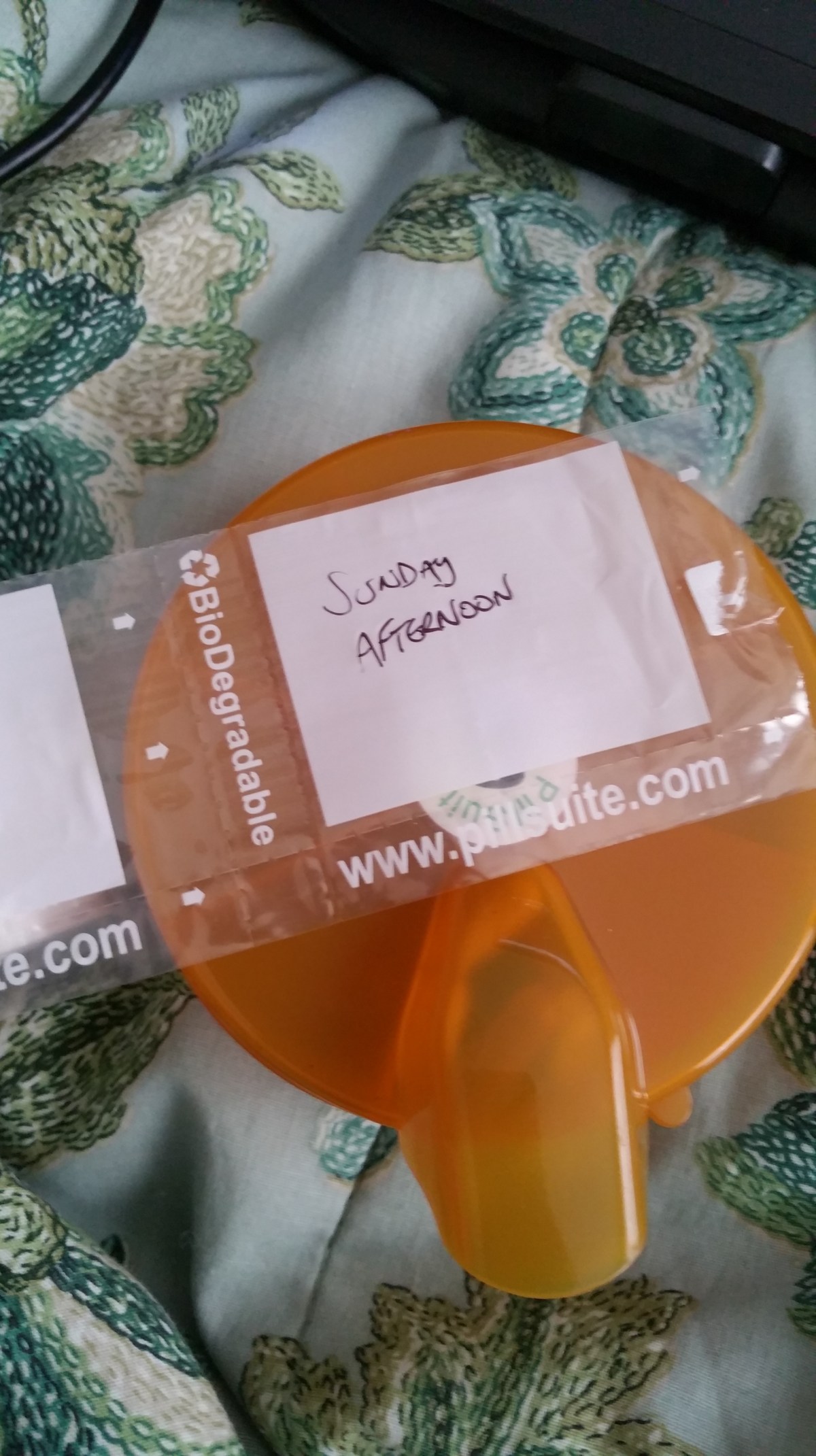
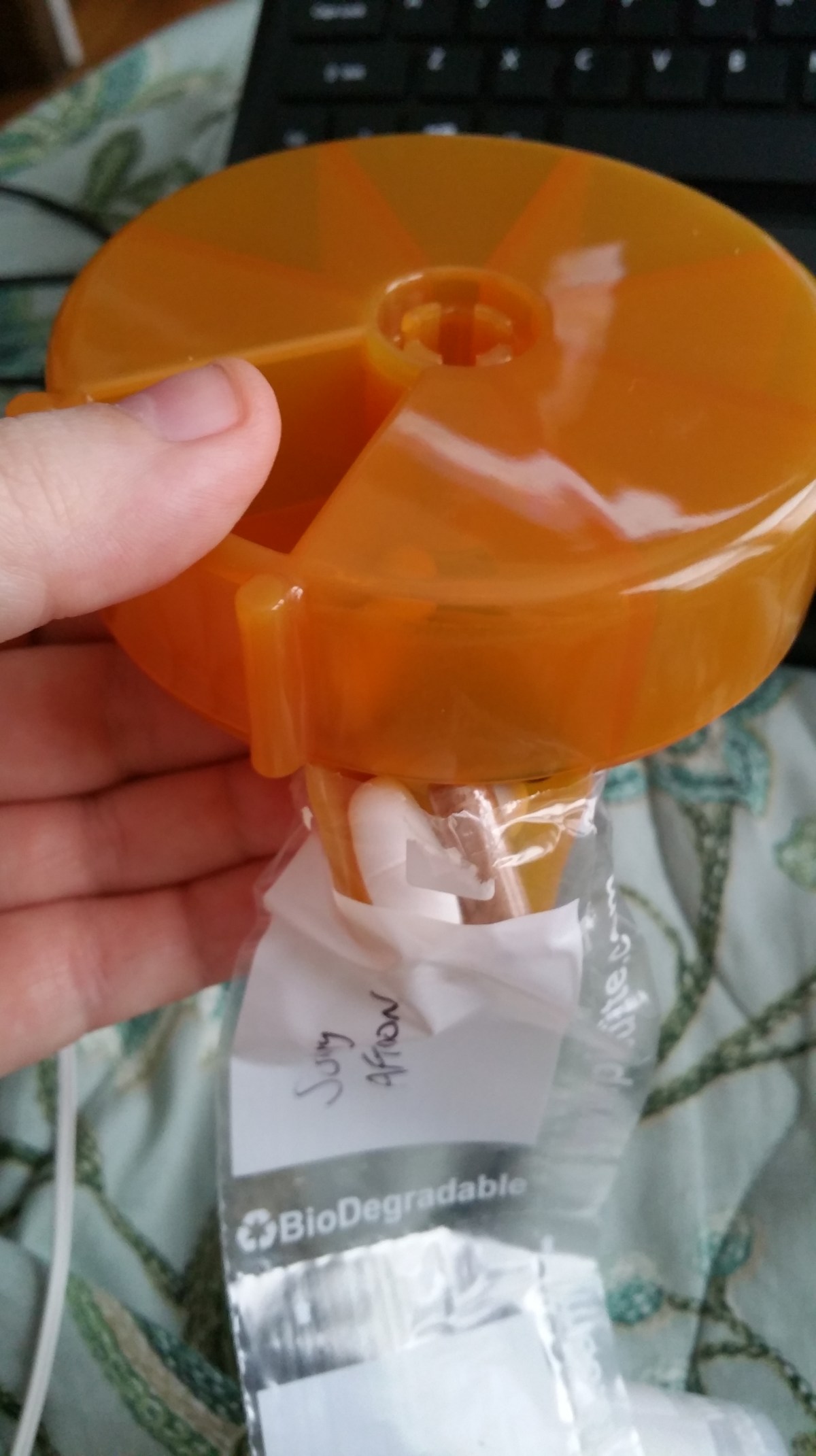
The baggies are biodegradable and can be written on with any sort of note you choose to write; I recommend a fine-tip permanent marker.
2016-03-27 11.41.51

After you snap the lid onto the sorter, you flip it over so the funnel lines up into the open end of the next plastic baggie to load up the dosage.
2016-03-27 11.42.25
There was just enough room to get these horse pills into this baggie, just like there was just enough room in the compartment.

Next, the open edge of the baggie is pushed to the back of the sealer and the big button is depressed for 3-5 seconds, which seals the baggie shut with a fine line. The red indicator light shows that the sealer is working its magic and closing off the baggie.
2016-03-27 11.44.07
After that is done, both ends are completely sealed, and your meds and supplements are ready for transportation.

When you are ready to consume them, there is a perforated end that can be easily torn open.
2016-03-27 11.44.52

Here are some advantages to using this product:
1. You bet I like the fact that the baggies are biodegradable! I’m always worried about how much I consume and add to the demise of our resources because it’s not easy for me to do things that able-bodied people take for granted. Check out this episode of In Sickness + In Health podcast (http://www.insicknesspod.com/blog/2016/3/8/23-when-sus).
2. I can write anything I want to on the baggies. I can indicate the medication names and dosages, or I can indicate the time of day the pills should be taken, or I can remind myself to take the contents on an empty stomach an hour before eating, etc.
3. This is a great product for traveling. Sometimes I have appointments that require a lot of time for me to be away from home, and it would be a lot easier to slip one of these baggies in my purse than it would be to take a pill sorter or an actual bottle (or seven) with me. This would be pretty handy for a short trip as well. The only time it wouldn’t work is traveling outside the country; TSA requires medications to be in their original prescription bottles when traveling outside the U.S.
4. This takes the mystery out of whether you have missed dosages or not, especially if you have scripts or supplements that are taken 3-4 times a day or you have to stagger everything according to a full versus an empty stomach. I have yet to see a pill sorter that has enough compartments for all of my dosages.

One disadvantage for me? My evening dose of meds and supplements actually adds up to about 25-30 pills and capsules – the seven that you see here, plus a bunch more, depending on how I am feeling. I would actually have to fill two compartments in the sorter and therefore two baggies for the nighttime dosages.

Ordering additional “suites” as the baggies are called is impressively inexpensive from http://store.pillsuite.com/.

Now You See Me

About a month ago, my fellow blogger Nikki (As I Live and Breathe, http://ilivebreathe.com/blab-archive/) and I started hosting sessions on Blab to talk about topics that concern us as patients with rare diseases and chronic diseases. We’ve had a lot of fun and have learned along the way what has worked and what hasn’t. Nikki also keeps seats on lockdown so we don’t have bullies show up on camera (though we can’t control trolls that come in and leave after they have said nasty, vile things). It’s pretty easy technology once you get the hang of it. I hope that you will consider joining us for our #SickadillyChat every Friday around 4 pm EST/1 pm PST (times sometimes change by an hour or two earlier if we have something that is going on – you can always subscribe to Nikki on Blab so you have the link for the show). If you are otherwise occupied, Nikki keeps a working list of our chats as they are recorded.

“Sickadilly,” according to the Urban Dictionary, means 1. To be fresh or poppin, or 2. To look beat. I mean, c’mon, we’re a little bit of both, aren’t we?

I consider us lucky to have the help of a few physician friends that Nikki has gotten to know well from her years of advocacy and education. Their enthusiasm and openness helps to keep us on the right track.

If you have ideas or topics you would like to cover, feel free to leave comments for Nikki or I. We also may approach people to join us, if they are able. We already have a running list of topics that we hope everyone will find interesting.

Here’s the latest one regarding apps and devices used to assist with your healthy living and healthcare from home, from February 26, 2016:
https://blab.im/nikkiseefeldt-sickadilly-chat-4-let-s-talk-about-tech-baby-ci-disab-rare-dis